A Fresh Look at Homosexuality in the Bible
by Michael Kioni Dudley, Ph.D.
This paper is available at https://a-fresh-look-at-homosexuality-in-the-Bible.com.
It can be copied, translated, reprinted, or published without any charge.
It does not have a copyright. Please give It the widest dissemination possible.
Introduction:
In the new book Leo XIV: The Biography, Pope Leo tells Vatican Journalist Elise Ann Allen “It seems to me very unlikely, at least in the near future, that the doctrine of the Church will change its teachings on sexuality and marriage . . . because, as we saw at the Synod, within the Church any theme related to the LGBTQ reality is highly polarizing.” “For now, I try not to fuel polarization in the Church.” “Ahead of changing Church doctrine, we must first change attitudes. (Greg Owen in Pope Leo says LGBTQ+ doctrine won't change anytime soon: "I have nothing more to add on this point" – LGBTQ Nation)
On May 5, 2026, the Synodal Study Group #9, created by Pope Francis to discuss changes in Church teaching on homosexuality, published its Document, found at SG-9_Final-Report.pdf. The Document speaks of the great change in the early Church when, guided by the Holy Spirit, the apostles opened the Church to the Gentiles. It teaches that such changes are necessary as the world and circumstances change. It states that emerging issues, such as homosexual acceptance, invite the People of God to undertake a re-reception of the Gospel of Jesus through an unguarded openness to what the Spirit says to the Churches today (SG-9 pg.8) It encourages parrhesia–bold, honest, fearless speech.
The members of the Synodal Study Group #9 read an earlier version of this paper. The author of this paper was one of only twenty-four scholars across the world whom the Study Group invited to comment on their Document before re-working and publishing a final version.
This paper is indeed a fresh look at homosexuality In the Bible. It starts all over, with a clean slate, with no preconceived notions, just looking at what the texts actually say.
The hope of the paper is to change attitudes by presenting stunning, true facts and conclusions, such as that there actually are no statements in the Old Testament or the New Testament, including all of the teachings of Jesus and the writings of St. Paul, that in any way speak of ordinary homosexual life, togetherness, and copulation as sinful. The paper will also establish that both the Old Testament and the New Testament hold stories that look favorably on homosexuals, which stories have been purposely unnoticed or consciously ignored by Christian Churches. It will further show that statements that homosexuals turn against their nature when lusting after another of the same sex are totally discredited by recent scientific studies that show that homosexuals, bisexuals, and lesbians are commonly found in 1,500 lower species, among whom and from whom humans have evolved, and that homosexuals, bisexuals, and lesbians are, therefore, to be expected among humans and are as much a perfectly normal type or gender as heterosexuals are. And it will show that in spite of church teaching, a number of homosexual saints have been recognized as homosexuals, yet still canonized, through the centuries.
All of this is submitted with respect for those who oppose Catholic acceptance of the full homosexual lifestyle, with the hope that many will read it, and that these honest truths will help to change their stand.
Gay people honored in the Old Testament
Like most peoples across the earth through ancient times, the Jewish people recognized and accepted that there were those among them who were attracted to people of their same sex, and seeking love, permanent relationships, and copulation with them. They recognized that these men were often not as assertive, some were “soft,” and some were even effeminate. Like most other peoples in ancient times, the Jewish people accepted these people as equals, and saw their needs and lifestyle as normal. These are stories that honor homosexuals, bisexuals, and lesbians in the Old Testament.
The Biblical story of Joseph with the coat of many colors presents a man who almost certainly was gay. The fraternal birth order effect, one of the best-evidenced studies in homosexual research, finds that in males with three or four older brothers, the likelihood of homosexual orientation is doubled. Joseph was the eleventh son of Jacob. Some descriptions of Joseph and of his coat use words ordinarily reserved for women. For instance, at Genesis 37:3, the Septuagint, the earliest Greek translation of the Hebrew Bible, when describing Joseph’s coat, uses ποικίλον (poikilon), an adjective most often used in Greek literature for women’s ornate garments. And Genesis 39:6 describes Joseph as “beautiful in form, beautiful in appearance.” These two phrases appear together a number of times in the Hebrew scriptures, but are usually used to describe women. In Greek, καλὸς παῖς (kalos pais) is the phrase used most often to refer to the younger person pursued by or living with a same-sex older person. In the Greek Septuagint, παῖς (pais) is used a number of times to refer to Joseph. It is never placed right next to καλὸς (kalos), but scholars agree that the writers used the two words closely enough together and frequently enough to clearly give the idea of homosexuality, while not indicating that Joseph was “the sought after” rather than the stronger “seeker.” Finally, Joseph was hated by all but one of his brothers. Men in the culture of those days needed to be strong, dominating, and willing to fight anyone. They hated him because he wasn’t like that at all, hated him so much that they were going to leave him in a well to die, but instead sold him into slavery. Clearly, he was different. And there is no doubt that today we would agree that the difference was that he was homosexual. The whole story of Joseph eventually becoming such a major figure in Egypt is written with such admiration. Even though there was no way for people of that time to understand, appreciate, and support homosexuality, the story shows real openness and admiration for a man whom it is almost impossible not to recognize as gay.
The love between David and Jonathan is openly told in the Bible:
As soon as he had finished speaking to Saul, the soul of Jonathan was knit to the soul of David, and Jonathan loved him as his own soul. Then Jonathan made a covenant with David, because he loved him as his own soul. And Jonathan stripped himself of the robe that was on him and gave it to David, and his armor, and even his sword and his bow and his belt. (1 Samuel 18:1, 3-4)
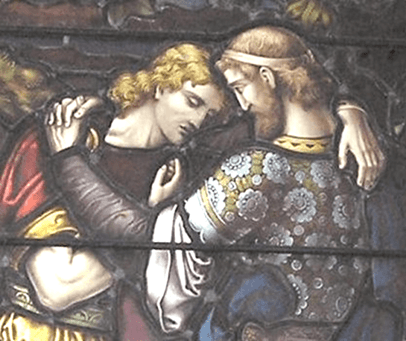
1882 stained glass window, St, Marks Portobello, Glasgow, Scotland
Jonathan had David reaffirm his oath out of love for him, because he loved him as he loved himself. (1 Samuel 20:17)
When David was leaving the area because Saul wanted to have him killed, “David fell to the ground and bowed three times to Jonathan. And they kissed one another and wept with one another, David weeping the most.” (1 Samuel 20:41)
At Jonathan’s death, David said: “I am heartbroken over you, my brother, Jonathan. You were my great delight. Your love was more wonderful to me than the love of women.” (2 Samuel 1:26)
The love between Naomi and Ruth is also told openly. Ruth 1:16-17 reads:
“Where you go, I will go, and where you stay, I will stay. Your people will be my people, and your God my God. Where you die, I will die, and there I will be buried. May the Lord deal with me, be it ever so severely, if anything but death separates you and me.”
It is interesting that this quote is used so often in heterosexual Christian marriage invitations, ceremonies, and receptions to express perfect love between heterosexual partners, when it was written by a lesbian to express her homosexual love for someone of her same sex.
The most important statement in the Bible supporting homosexuals and homosexual lifestyle is found in the Book of Daniel 1:9, which tells us that it was God Himself who “brought Daniel into favor and tender love with Ashpenaz, the prince of the eunuchs.”(King James Version) Daniel was a young man who had just come to Babylon with his Jewish people at the beginning of the Captivity. King Nebuchadnezzar told his Prince of the Eunuchs to find handsome foreign youths to serve in the royal court. The story fits the pattern of stories of eunuch-youth pederasty. Daniel is described as handsome, without blemish (Daniel 1:4). The language is emotionally intimate, unusually tender. Hesed, the Hebrew word for “kindness, deep bonds between people,” is used for “Into the favor”. (It’s also used for David and Jonathan’s bond). Rahamim, the Hebrew word for “tender feeling, emotional warmth, intimate affection,” is used for “tender love.” Ashpenaz takes Daniel to himself, into his deep bonds and intimate affection. God clearly was placing Daniel in a homosocial environment. The Persian and Babylonian courts are the best-documented ancient settings for same-sex relationships among eunuchs. If it is right there in black and white that God Himself led Daniel into it, how can we believe that God condemns homosexual love, togetherness, and copulation?
It is not just the persons mentioned in the texts of the Old Testament that are homosexual. There are also places where the story itself is written from an unmistakable same-sex enamored view. Such is the story of Absalom in 2 Samuel, where the male writers themselves are clearly obsessed by the beauty of Absalom, and offer a loving male gaze at male beauty. At 2 Samuel 14:25 we find, “And in all Israel there was no man so exceedingly beautiful as Absalom.” The narrator then pauses the story to describe Absalom’s entire body, head to foot, as flawless. In describing his hair, he even mentions its weight, its luxuriance, its annual cutting. Later, Absalom leads a rebellion against his father, King David, after winning the support of the men of Israel. 2 Samuel 15:6, however, in telling of this, says, “And Absalom stole the hearts of the men of Israel.” When he is killed, the story focuses on the deep, deep grief of David over the loss of his son, rather than on the rebellion that still could replace David. David loves him so much that he says, “Would I had died instead of you, O Absalom, my son, my son.” This story of Absalom shows us that writers of the Old Testament could tell a story from their same-sex-loving thought framework, and that it was well received by everybody. At that time, although they didn’t understand homosexuality like we do, it was fine for men to fall in love with men.
The Catholic Church currently does not accept that however, so we never hear these stories. Scripture scholars avoid discussing them. And those who have created the three-year cycle of Scriptural readings for Sunday Mass and daily Mass have assiduously avoided letting them be known. (Only the mention of Ruth’s commitments to Naomi is contained in the three-year cycle of Sunday readings, and then only as an alternate reading.) As an example of avoiding public mention of anything in Scripture that is pro-homosexual, the first quote on the love relationship between David and Jonathan, which appears above—"Then Jonathan made a covenant with David, because he loved him as his own soul”–is found at 1 Samuel 18:1, 3-4. The daily Mass readings pass this by, but tell a story that begins just one verse away at 1 Sam 18:6–9, where Saul is angered because the people are cheering David so much for killing the Philistine giant. Such selectivity is an effort to make Scripture agree with Church teaching, rather than Church teaching agree with Scripture. Hopefully, the above stories that look favorably on same-sex love will be made known as the Church acknowledges that its stand on homosexuality is completely man-created, not taught by God.
The Ten Commandments.
The Ten Commandments forbid adultery and coveting a neighbor’s wife, but there is not a word prohibiting same-sex love, togetherness, and sex. God is all-knowing. God gave Moses Ten Commandments. If He had wanted to give eleven Commandments, He could have. But He didn’t.
King Solomon had 700 wives and 300 concubines, because there was no reason not to. There was nothing in the Commandments. The same was true of the love between King David (who also had at least eight wives) and Jonathan. Nothing told them this was wrong or sinful, and it wasn’t. It is agreed among scholars that ordinary homosexuals were commonly accepted by the people of the Near East, including the Jewish people, throughout the B.C.E.
The story of Sodom and Gomorrah
It must be stated clearly that from Biblical times till today, no Jewish writer in any way sees homosexuality as the focus of the story of Lot, the visiting angels, and the threatening men of Sodom. That’s just not what the story is about.
A similar story is told in Judges 19, with different characters. The purpose of both stories is to address the very great moral obligation and sacred duty for Jewish people to provide hospitality for travelers. Both stories illustrate the extremes people should go to protect their guests—in Judges, to do this, a concubine is offered for rape; in Genesis, Lot offers his two daughters to the townsmen in order to protect the visitors.
Sodom and Gomorrah were known for not wanting travelers to stop, and for humiliating and showing hostility and violence to those who d,id in order to get the word out. In this story, all of the townsmen come, intending to sexually abuse the visitors throughout the night. This has nothing to do with ordinary homosexuality whatsoever. It is an effort to give the visitors the ugliest, most humiliating, degrading, and shameful treatment possible in order to discourage other travelers from visiting.
Ezekiel 16:49-50 lists the sins for which Sodom and Gomorrah were destroyed as pride, gluttony, prosperous ease, failure to help the poor and needy, haughtiness, and abominations.
Isaiah 1:10-17 lists the sins as injustice, oppression, violence and bloodshed, corrupt worship, failure to defend the orphan, and failure to plead for the widow.
No writer in the New Testament connects the story with ordinary homosexuality, either. Jesus mentions the story three times, but never with any homosexual connection. Paul talks about ordinary homosexuality in Romans, but makes no connection with this story. The first connection of the story with homosexuality is made by a Jewish writer, Philo of Alexandria (c. 20 BCE–50 CE), who was shown little regard by the Jewish people, but who greatly influenced Christianity.
There is actually no basis for claiming this story condemns ordinary homosexuality, let alone any basis for making it the primary Biblical citing for the claim that homosexual life is sinful. No homosexual act takes place in the story. There is no mention of, nor condemnation of, ordinary homosexuality in the story. The townsmen clearly are not homosexuals since Lot offers them his daughters. To use the story to condemn ordinary homosexuals and their life and sex together is simply without basis, justification, honesty, or truth.
If no writer of the Bible itself makes the connection, nor does Jesus, and the story actually has no clear connection with homosexuality, why do the Catholic Church and other Christian Churches continue to use the story of Sodom as their principal example of Biblical condemnation of ordinary homosexual life? It is time for the real facts to be brought out, and for Churches to publicly state that the story does not condemn ordinary homosexual life.
Leviticus
Many cite Leviticus 18:22 and 20:13 as the places in the Old Testament where homosexual life is condemned. But it is not ordinary homosexuality that is addressed in these passages. Scholars today argue that one can only translate the two passages as a condemnation of all homosexual activity if one adds words that aren’t there. Many also note that the Hebrew text of Leviticus 20:13 clearly shows that it is not man-with-equal-man sex that is being described. If it were, the Hebrew nouns would be ish “man” with ish “man,” not ish “man” with zachar “male.” The use of two different words indicates that two different kinds of males are being discussed. Pederasty–the sexual relationship between an adult man and a boy–was a common practice in Persia during the Babylonian Captivity of the Jews when Leviticus was put into written form. Scholars, today and in the past, knowing the prominence of pederasty in the land of their captor, have maintained that both statements in Leviticus either condemn pederasty or, possibly, the rape of a male by a male family member. Martin Luther, in his translation of the Bible, used the word knabenschander, “boy molester,” to describe the act condemned in Leviticus.
These two passages in Leviticus, then, do not address ordinary homosexual life, togetherness, and copulation.
In summary, it can be clearly stated that “No Jewish writer in Old Testament times whose opinions have come down to us has ever written any opposition to ordinary sexual attraction, life together, or sex.”
The teachings of Jesus
Jesus mentions Sodom and Gomorrah three times: in Matthew 10:5-15, when sending the Twelve out to preach, he says that if a home or town does not receive them, it will be worse for them on the day of judgment than for Sodom and Gomorrah. The sin referred to here is lack of hospitality, just as it is in Luke 10:1-15, where Jesus says the same thing when sending out the seventy-two. In Luke 17, Jesus mentions Noah and the flood and Sodom and Gomorrah in order to tell his listeners that at the end of time, all will be destroyed, all people will die. Clearly then, in the mind of Jesus, the story of Sodom and Gomorrah has nothing to do with homosexuality.
Jesus also never says anything negative about homosexuality. In fact, he seems to be quite open to it.
In Matthew 8:5-13, he heals a Roman centurion’s pais, which in this case most likely means “male lover or younger male partner,” and he praises the centurion for his faith as a non-Jew coming to ask Him for the cure. He says nothing negative about the Centurion’s same-sex love relationship. The author of the Gospel also preserved the story without any disapproval.

In Luke 17:22-37, a passage where Jesus says He is the lightning flash and will dwell where the eagles are, translators ignore the connection that Jesus is making between himself and Zeus (called Juppiter in Rome) who is often pictured holding a lightning bolt and an eagle, and who dwells in the heavens. The people of Israel knew the story of Zeus/Juppiter well. They knew that Zeus saw the extremely handsome Ganymede living on earth, and sent an eagle to bring him to the heavens to be his same-sex lover. In the passage in Luke, Jesus similarly says: “At the end of time, there shall be two men lying in the same bed; one will be taken (to heaven), the other left behind. There shall be two women grinding at the same place (ἐπὶ τὸ αὐτό); one will be taken, the other left behind.” “Grinding” was a word commonly used in Hebrew, Aramaic, and Greek at that time for “sexual activity.” (Compare Job 31:10; Lamentations 5:13, and Judges 16:21.) In Matthew 24:40-41, Jesus talks of two men working in a field and two women grinding at the mill, with one of each taken to heaven. Here, he changes the two men in the field to two men in bed, with two women grinding in the same place. Two men in a field is not found in any of the early Greek copies of Luke 17. When asked where they will be taken, Jesus answers: “Where the eagles are,” that is, where He will dwell in the heavens. He is taking gays to heaven just as Zeus took Ganymede to heaven.

Ganymede
In Matthew 19: 17-19, Jesus lists the commandments one must keep. He includes “You shall not commit adultery” among them, and he adds a new one: “Love your neighbor as you love yourself.” This would have been the place for Jesus to also add “You shall not copulate with another of the same sex.” But he did not. That was not his teaching.
Lazarus never married. When he was dying, Mary and Martha sent word to Jesus saying, “Lord, the one that you love is sick.” Jesus waited three days before going down to raise him from the dead. Was this to give him the honor of spending the same time in death as Jesus? Did Jesus love him that much?
Jesus had a close, loving relationship with John. There is no way today to establish with certainty that John was homosexual, but there are many signs that he was gay and in love with Jesus. John’s Gospel states five times that he is “the disciple whom Jesus loved.” He wrote it five times, so that it could not be ignored. John also writes that at the Last Supper, “There was at table one of His disciples–the one Jesus loved–reclining with his head on Jesus's bosom” (John 13:23). To make sure readers have noticed what he is saying, in verse 25, John again writes that Peter asked him whom Jesus was speaking about and “He, then, resting his head on Jesus' breast, said to him, ‘Lord, who is it?’” Gay men know the joy and deep love they experience when lying next to and resting their head on the chest of their beloved. It also should be noted that none of the disciples thought it extraordinary for John to lay his head on Jesus’ chest. They fully accepted it. And, since there was no reaction from them, it most likely was not the first time. The love of John for Jesus was so deep that, while all of the other apostles were hiding in fear, John was willing to give his life if necessary in order to be with Jesus suffering on the cross. And Jesus felt close enough to John to entrust the care of his mother to him, calling John, like Jesus Himself, the Son of Mary: “Mother, behold thy Son.” John seems to have never married. When we realize that Jesus allowed a man to lay his head on his chest at the Last Supper and that the Apostles accepted it as normal, and when we realize that Jesus made this gay man the son of Mary as He Himself was the son of Mary, it is impossible to say that Jesus opposed homosexuals and homosexual lifestyle.
Although, in our homophobic and prejudiced world today, Churches totally ignore this love, medieval Christians embraced it in their art and in their writings, spiritualizing it, calling it the ideal of contemplative love. In their writings, St. Aelred of Rievaulx, St. Bernard of Clairvaux, and St. Bonaventure were comfortable in using tender, even romantic-sounding—though not sexual—language when describing the deep loving bonds between John and Jesus.
St. Paul
So, if the Church’s condemnation of ordinary same-sex attraction, togetherness, and sex did not come from the Ten Commandments or the Old Testament and did not come from Jesus, where did it come from?
It primarily comes from St. Paul, though Paul himself is extremely careful not to call it sin. His letter to the Romans 1:26-27 is the only place in the entire Bible that actually addresses the actions of ordinary homosexuals. Paul says that they act shamefully in lusting after others of their same sex, since they are turning against their nature.
From long before Paul’s time and down to the present, it has commonly been believed that God revealed to Moses the details of His creation of Adam and Eve, and that Moses retold the story at the beginning of the Book of Genesis. In Genesis, God created only Adam and Eve, both heterosexuals with a desire for each other, and all humans since that time have been born as male or female heterosexuals. Today, however, we are aware that there are two creation stories at the beginning of Genesis, and that many of the facets of the stories–humans formed from clay, a divine garden or paradise, a test involving food, a trickster or deceiver figure, and loss of immortality—are found in creation stories across the Near East. Scholars today accept that our Biblical story of creation was probably formulated over time by the Hebrew people as they adopted and reframed ideas they shared with surrounding peoples. Most Churches no longer insist on belief in the story of Adam and Eve, or on acceptance that the world is composed only of heterosexual males and females.
Paul’s understanding that homosexuals turn against their nature when lusting after others of the same sex completely falls apart when confronted with the fact that biologists have recently documented same-sex courtship, pair bonding, and copulation in over 1,500 lower species. (Nathan Bailey and Marlene Zuk, Trends in Ecology & Evolution, August 2009) A January 2026 article in Nature, Ecology, and Evolution further finds full homosexual behavior in 56 primate species, the highest level of mammals which includes humans.
If we recognize evolution as a fact and accept that we have evolved from lower species of animals, we must accept that human homosexuals, bisexuals, and lesbians are to be expected to exist, that they are consistent with all of nature preceding them, and that they are a completely natural portion of humanity. We can no longer accept any claim that homosexuals turn against their nature when enjoying same-sex courtship, pair bonding, and copulation. They are acting completely according to their nature. Human homosexuals are what God created them to be. The nature God has given them now needs to be sanctioned by the Church and their desires, togetherness, and sexual life declared to be without sin.
There is another very good reason for rejecting Romans 1:26-27 as a valid Church teaching. Paul grew up in the Diaspora, in Tarsus, Turkey, in a Jewish community in a very Greek city. He was raised speaking Greek, and was thoroughly educated in Greek thought and philosophy. He was very aware of Stoic philosophy’s teaching that living according to one’s nature is the foundation of a good and rational life, and turning against one’s nature is wrong, and the root cause of human misery. He used this Stoic teaching—turning against one’s nature–as the basis for his opposition to homosexual life. It must be pointed out, then, that Paul’s negative teaching about homosexual acts in Romans 1:26-27 is grounded in pagan philosophy, not Jewish or Christian. It is based on man-made teachings, having nothing to do with the divine.
A final reason for rejecting Romans 1:26-27 as a valid Church teaching is that, as we found with the story of Sodom, our Churches are basing their teaching on things that just aren’t there; they are applying a passage to people other than those intended; and they are viewing words as doctrinal condemnations for Christians when they aren’t that at all. One needs to read verses 26 and 27 in the context in which they are written, starting at 1:18. Paul is actually talking about idolatry and what happens to idolators, not the Christian community. “They exchanged the glory of the immortal God for images resembling a mortal human being or birds or four-footed animals or reptiles.”(Romans 1:23) He writes: “26 Because of this, God gave them over to shameful lusts. Even their women exchanged natural sexual relations for unnatural ones. 27 In the same way, the men also abandoned natural relations with women and were inflamed with lust for one another. Men committed shameful acts with other men, and received in themselves the due penalty for their error.” He’s not talking about Christians. He’s talking about non-Christian idolaters. He’s not laying down a law for Christians to observe. He’s saying that God led pagans to do this, as a punishment for their idolatry.
Most importantly, he calls their actions “shameful,” not sinful, and he doesn’t say what the due penalty was for their lust and sex. Paul uses the word ἁμαρτία (hamartia), the standard Biblical word for “sin,” forty-three times in the Letter to the Romans alone, forty-three times! That’s an average of about three times per page. But he specifically avoids using that word here, instead using the word ἀσχημοσύνην (aschēmosynēn) which means “shame.” Thus, when one reads Romans 1:18-27 as Paul intended it to be read, knowing he used the word for “sinful” 43 times elsewhere in that short Epistle, but specifically refers to these homosexual acts as “shameful” rather than “sinful,” one can only agree that, while Paul looked upon these acts negatively, he wanted to be sure that his readers realized that he was not calling them sinful.
Further, Paul wrote this letter to the Romans. He did not send it to all of the Churches. It was never meant to be a law for all Christians. For the Churches to extract verses 26 and 27 from their context, and ignore that it calls the acts “shameful” rather than “sinful,” and for them to use the passage as the basis for formal doctrinal law that contradicts the Old Testament and the teachings of Jesus, was a grave mistake. It was also a sinful crime against gay people that has been multiplied millions of times by hurtful actions against them in every generation since.
Before leaving the discussion of St. Paul, let me note that there are two other instances where Paul may be talking of ordinary homosexual life—1 Corinthians 6:9-10 and 1 Timothy 1:9-10, but he coins a new word, arsen (male) + koite (bed) “male-bedder,” which is not found elsewhere in the Bible, and which he doesn’t further define. Scholars find no way to determine what kind of male-bedder it refers to—an ordinary homosexual, a prostitute, or a partner in pederasty.
For all of the reasons above, Romans 1:26-27, which is the only place in the Bible that describes ordinary homosexual life, must itself be laid aside as a valid condemnation of homosexual life. A number of major Christian denominations are changing their doctrine on homosexuality today. The recent findings of homosexuality, bisexuality, and lesbianism in so many lower species of animals gives the Catholic Church an honest excuse and a great reason to at this time come to grips with all of the realities discussed in this paper and to change its teachings. There will be those who will resist laying aside the Adam and Eve story and accepting evolution. But over the centuries, the Church has laid aside many other major doctrines. For instance, Christian churches no longer teach that slaves must be obedient to their masters.
How did the view that homosexual acts are sinful enter the early Church?
It would be interesting to study how the teaching that ordinary homosexual acts are sinful came into the Church. But our purpose in this paper is to simply establish that there is no basis whatsoever in scripture for declaring ordinary same-sex attraction, life together, and copulation to be sinful. There are a number of books and papers on the topic of how condemnation of homosexual acts entered Church teaching. There were many influences.
It should be noted that it took a few centuries for everyone in the early Church to share the same beliefs and practices. The Council of Elvira (Spain) issued Canon 71 in 305–306 CE. This is the first known formal ecclesiastical law that explicitly legislated punishment for same-sex sexual acts. It ruled that men who engaged in same-sex copulation could not receive communion even on their death bed.
Even with this kind of Church law, however, there have been times and places throughout history where we find stronger and weaker observance. Governments became involved. People were imprisoned and burned at the stake. Today 65 of the 195 countries in the world still outlaw homosexual acts. One third of the countries in the world. Surprisingly, at the same time, however, throughout history, there has been recognition of, and pastoral care for, same-sex couples. And even recognition of them as saints.
Church Ceremony to Unite Same-Sex Couples
For instance, there was a ceremony called adelphopoiesis which united same-sex couples (normally men) in a church-recognized relationship analogous to brotherhood. This ceremony existed in the Catholic Church until the 14th century, and in the Eastern Orthodox Church until the early 20th century. According to the copies of the ceremony text that are still extant, there was nothing in the ceremony that “married” the couple or that accepted same-sex intercourse. However, the ceremony very closely paralleled the Byzantine marriage ceremony with many of the same actions and same wordings. And there is little doubt that, while the Churches used the ceremony to declare homosexuals to be brothers, many homosexuals used the ceremony as a way to get some spiritual recognition for their lives as same-sex lovers.
Gays venerated as saints through the centuries
Although a formal process of canonization would not exist until the 12th century, from early times, there were gay women and men who were recognized as saints and had churches dedicated to them. And once canonization was necessary to be declared a saint, even though candidates went through the scrutiny of the canonization process, strangely, the recognition of homosexuals as saints has never stopped. Let us list some homosexual saints.
Saints Perpetua and Felicity
These were lesbian lovers imprisoned and martyred together in 203 C.E. They had churches, even a basilica, dedicated to them. All of these saints are discussed in an article found at 30 LGBTQ+ Religious Saints Throughout History (advocate.com)

Sergius and Bacchus
This pair of Romans who would eventually convert to Christianity were described in early Greek text as “erastai” or lovers, and may have been bonded in the “brother-making” ceremony, adelphopoiesis. The two were tortured to death around 303 A.D. after refusing to attend a sacrifice to Zeus.
Polyeuct and Nearchus
These Roman soldiers were among the first same-sex lovers in the days of the early church, according to Yale historian, John Boswell. A church would later be built in Polyeucts’s name in Constantinople, and scholars point to this relationship as evidence of acceptance in the third century of same-sex relationships.
Symeon of Emessa and John
These sixth-century Byzantine figures met on a pilgrimage to Jerusalem. The two ended up being joined in an early form of same-sex union before living together as hermits in the deserts for twenty-nine years. Eventually, Symeon left to form a church in Emessa, despite emotional pleas from John to stay. The two would be honored together as saints and share the same holy day.
Bernard of Clairvaux and Malachy of Armagh
Born in the 11th century, Bernard of Clairvaux eventually became a Cistercian abbot. He is known for his emotional writings on love and desire, and homoerotic poetry about Jesus. He maintained a lengthy personal relationship with the archbishop Malachy. After Malachy, an Irishman who also became a saint, died in Bernard's arms, Bernard wore the deceased religious leader's habits for his remaining years. Upon his own death, Bernard was buried alongside Malachy on church grounds.
Aelred of Rievaulx
Born in 1110 in Northumberland, he became a Cistercian monk at Rievaulx Abbey and eventually became the abbot of the same abbey. Aelred left behind homoerotic writings and had close relationships with male friends. His book Spiritual Friendship investigates the notion of spiritual affection shared between men, which he deemed instrumental in fostering a closer connection with the divine.
Saint Joan of Arc
Joan of Arc was born in Domrémy, France, in 1412. Hearing Saint Michael, Saint Catherine, and Saint Margaret’s voices started when she was 13, and they told her to lead the French army to victory in the Hundred Years’ War against the English. She reportedly shared a bed with women and refused to marry a man. The English found her guilty or wearing men’s clothes, among other things, and burned her at the stake in 1431. She is a transvestite saint.
John Henry Newman
The 19th-century British subversive scholar was beatified in 2010 despite speculation that he may well have been gay. He lived for several years with Ambrose St. John, and though the men are believed to have remained celibate, Newman wrote that St. John "loved me with an intensity." Newman asked to be buried beside St. John.
Proposed Content for New Roman Catholic Teaching Statements
In light of all of the above, and with the hope that the Roman Catholic Church will promulgate new teachings on homosexuality, these are contents for Catholic Teaching statements which this author personally supports:
The Roman Catholic Church now teaches that homosexuals, bisexuals, and lesbians are born as such, and that God has given them this nature, intending that they live their lives fully enjoying same-sex courtship, living together, and copulation, and that they do so without sin.
The Roman Catholic Church discourages homosexuals, bisexuals, and lesbians from entering opposite-sex marriages, and recognizes that most true homosexuals and lesbians, because of their nature and needs, cannot make valid marriage vows with persons of the opposite sex.
The Roman Catholic Church recognizes that many millions of people have entered marriages with the opposite sex because of the expectations and demands of society. The Church further recognizes that many of these have become unhappy marriages, or marriages where the gay person now wishes to pursue his or her own nature, or the straight partner wants to be free. It encourages its bishops to use their authority to dissolve such marriages.
The Roman Catholic Church recognizes that many of its priests and Religious are homosexual, bisexual, or lesbian, and have joined the priesthood or Religious Orders in order to avoid the married life. Many of these will now want to be free of their vows. While asking them to continue their current lives, bishops are also encouraged to release those from their vows who feel the need to leave.
The Roman Catholic Church recognizes that many homosexual, bisexual, and lesbian priests and Religious will want to continue their service while being allowed to live their gay lives more fully. It notes that definitions of celibacy and chastity include “the sacrifice of marriage” and “refraining from sexual intercourse.” Expressions of love such as those described in the story of David and Jonathan and at the Last Supper can be enjoyed as long as they do not lead to sexual intercourse.
Summary Statement
We have slowly come to see, then, that there is no statement anywhere in the Bible condemning ordinary homosexual, bisexual, or lesbian attraction, love, togetherness, or copulation as sinful. It is not found in the Ten Commandments given by God to Moses. It is not found in the writings of the Old Testament. Instead, the Old Testament gives us stories of homosexual love and even tells us that God led Daniel into such a relationship. It is not found in the teachings of Jesus Christ. He, instead, shows that he is very open to it and has no negativity toward it at all. The Gospel writers also are open to it, reporting homosexual encounters without negative comment. And it is not found in the writings of St. Paul, who takes great care, when showing his personal prejudice against homosexual actions, to not call it sin.
When one realizes all of these things, one is compelled to agree that the Bible is actually teaching that ordinary homosexual life is normal, acceptable, and sinless.
Throughout history, most Jewish sects have held onto the belief that homosexuality is totally acceptable. The Christian Church somehow got taken in by powerful teachers. And such unbelievably terrible things have come from it. Governments have ordered public thrashings, imprisonment, and execution of homosexuals with the blessing of the Church. Billions of homosexuals, in generation after generation over the last two thousand years, have suffered rejection, exclusion, taunting, insults, homophobic hatred, threats, beatings, and even murder because of this Church teaching. And for so many, this treatment from outside has been accompanied by interior struggle with Church condemnation, self-condemnation, and self-hatred, ending too often in suicide. This must be brought to an end as soon as possible.
If, after reading and checking out this paper, you can now accept what it states as truth, please help us end the maltreatment of homosexuals by getting it the widest dissemination possible worldwide.

Michael Kioni Dudley, Ph.D.
Kapolei, Hawai’i USA
Email: DrKioniDudley@hawaii.rr.com
Dr. Michael Kioni Dudley is Catholic. He lived as a teaching Brother of the Congregation of Holy Cross for fifteen years. He holds a Master of Arts degree in Catholic Theology from St. Mary’s University San Antonio, and a Master of Arts degree in Asian Philosophy and Ph.D. in Philosophy from the University of Hawai’i. He taught Religion at (Catholic) Chaminade University of Honolulu for eight years and in the University of Hawai’i system for sixteen years. Recently, he was selected as one of twenty-four theologians worldwide who were asked to read and comment on a document on new Catholic homosexual teachings prepared by the Synodal Study Group at the Vatican. He was very happily married to his soul-mate, Doris, for forty-three years. He is homosexual. He is 86 years old.
This paper is available at https://a-fresh-look-at-homosexuality-in-the-Bible.com.